Think Different, Build Bold: Your NASA Space Apps Challenge 2025 Guide

So… a lot of people have been asking us lately about the NASA Space Apps Challenge.
If you don’t know what that is, picture this: the world’s biggest hackathon — 90,000+ people across 160+ countries all coding, designing, and problem-solving at the same time for one wild weekend. Yeah, it’s as intense (and fun) as it sounds.
We want to share our journey because we hope our story shows what’s possible when you just give it a shot.
During orientation, we found out something that instantly lit a fire in us: no UAE team had ever won before. Some made it to the finals, but that was it. And we thought: “Why not us? Why not now?” That was the start of our insane dream to become the first team from here to actually win.
What’s the NASA Space Apps Challenge?
It’s not just another coding competition. NASA Space Apps is about solving real-world problems using NASA’s open data. You get one weekend, your brain, your team, and infinite coffee.
The themes usually connect to science, environment, and global challenges (sometimes tied to the UN’s Sustainable Development Goals). The cool part? Your project could actually inspire real-world change.
Our Challenge
The challenge we picked was about the United Nations’ 2030 Sustainable Development Goals (SDGs). Specifically, the task was:
Develop a lesson plan that teaches high school students about one SDG, and integrate it into a science subject (like weather, geology, soil health, etc.) so teachers can use it in their curriculum.
Sounds straightforward, right? Make a lesson plan, align it with science, done.
Would we have found that fun back in school? (Answer = nope.)

So instead of stopping at a lesson plan, we built:
Eco-Metropolis: A sustainable city simulation game where students step into roles (city planner, policymaker, etc.), make decisions, and instantly see the consequences of those choices. Want to build more factories? Cool — but here comes the pollution. Want to invest in green energy? Great — but it costs more upfront. Students weren’t just learning, they were living the SDG challenge, powered by actual data from space.
That’s what made us stand out.
👉 You can check it out here: Eco-Metropolis Sustainable City Simulation – GitHub
What We Learned (aka Stuff I Wish Someone Told Us Beforehand)
Here’s the real talk — the lessons we wish every future NASA Space Apps Challenge participant knew:
Choose the Right Challenge (Then Flip It on Its Head)
Don’t just answer the prompt; stretch it. We looked for ways to expand the challenge, to do something extra, something different. Everyone else will give the “expected” answer. The judges remember the ones who add a twist. Our twist? We decided not just to teach, but to immerse. Turning a boring lesson plan into an actual playable city simulation backed by real data.
Think Outside the Box
If everybody else is submitting a lesson plan, how can you reimagine it? What would grab attention? What would people say, “This is so cool !”? That became our goal — to make something memorable.
Time Is Your Biggest Enemy
You only get 48 hours. And trust me, they fly by. Half of Day 1 can disappear if you’re still pondering which challenge to pick. Pro tip: walk in knowing your challenge, rough roles, and maybe even a few ideas. Then use the hackathon weekend to execute, not just brainstorm.
Also, small but big tip: plan food, travel, and breaks. Hungry, cranky teammates don’t win hackathons.
Pick Your Team Like You’re Casting an Avengers Movie
This part matters more than you think. You don’t just need “smart people” — you need resilient, ride-or-die people. The ones who can survive sleep deprivation, stress, and those random 2 a.m. “Why are we arguing about fonts?” moments.
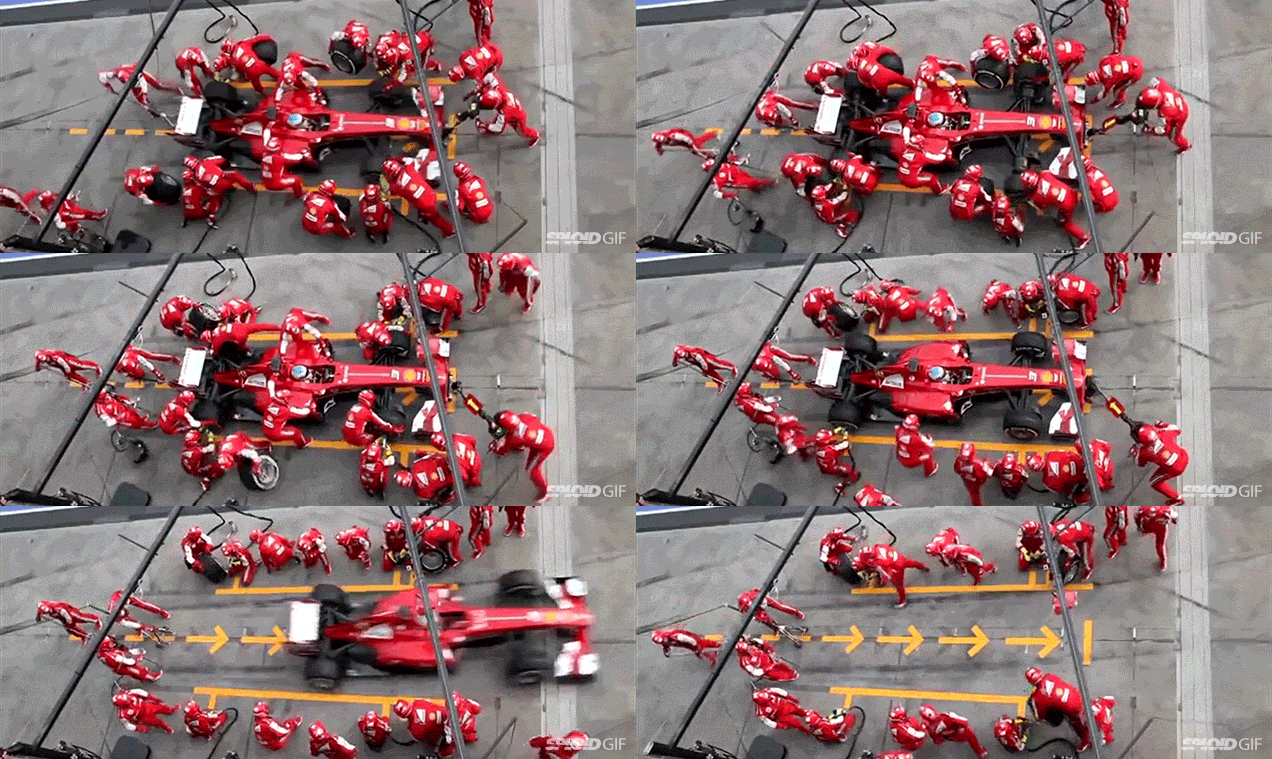
The right team feels like an F1 pit crew: fast, in sync, and always covering each other’s backs.
Demos Beat Features
Judges won’t care if your app has 20 microfeatures. They care if it looks and feels amazing during a 5-minute demo.
For us, the “wow” factor was the simulation and visuals, not some extra button buried in a settings menu.
Don’t Wait Until You’re “Good Enough”
Confession: this was our first serious tech hackathon.. We were honestly noobs compared to a lot of people. But we tried anyway… and ended up winning out of thousands of teams worldwide. Imagine if we hadn’t even bothered because we felt “not ready”.
And Finally: Have Faith
Yes, skills and strategy matter. But there’s also timing, luck, and blessings. For us, this win wouldn’t have been possible without Allah’s mercy. Staying grateful and humble kept us grounded.
This isn’t just about winning a hackathon. It’s about showing what’s possible. What we build in hackathons can ripple into the real world: cleaner cities, smarter policies, better tools. Competitions like the NASA Space Apps Challenge are about pushing forward what we can imagine and what we can build together.
So our message to anyone reading this: don’t hold back. Try. Create. Innovate. Even if you think you’re not ready. You never know — you might just make history too.
💡 Bonus Tips We Wish We Knew Before NASA Space Apps Challenge
Work smarter: use existing tools & prebuilt libraries.
Go beyond NASA datasets; extra data makes your project stronger.
Design for your users & tell your story, tech alone won’t impress.
Submit everything: datasets, images, prototypes, GitHub repo with full details beyond what’s shown in the demo. Judges do check.
If you’re traveling, factor in lost time. Joining virtually saved us hours.
Simple ideas presented well can win big.
Local leads = secret resource, reach out if stuck.
PS: We did win… but we also learned that 48 hours without proper sleep makes you see bugs that don’t exist.
— By: Shafeeqa, Rikzah, Samira & Umamah (Team Innovisionaries)